Don't get tricked.
False cause: two things in a row is not a reason.
"I took collagen for a week and my nails grew." You've said a sentence like that, and your brain filed it as proof. Here's the trick, where it shows up, and the one question that catches it every time.
Two things happen close together, so your brain gives the first one credit for the second.It doesn't run a check. It just closes the file. And sometimes the first thing really did cause the second, which is exactly why you have to check instead of guess. @heykayandco
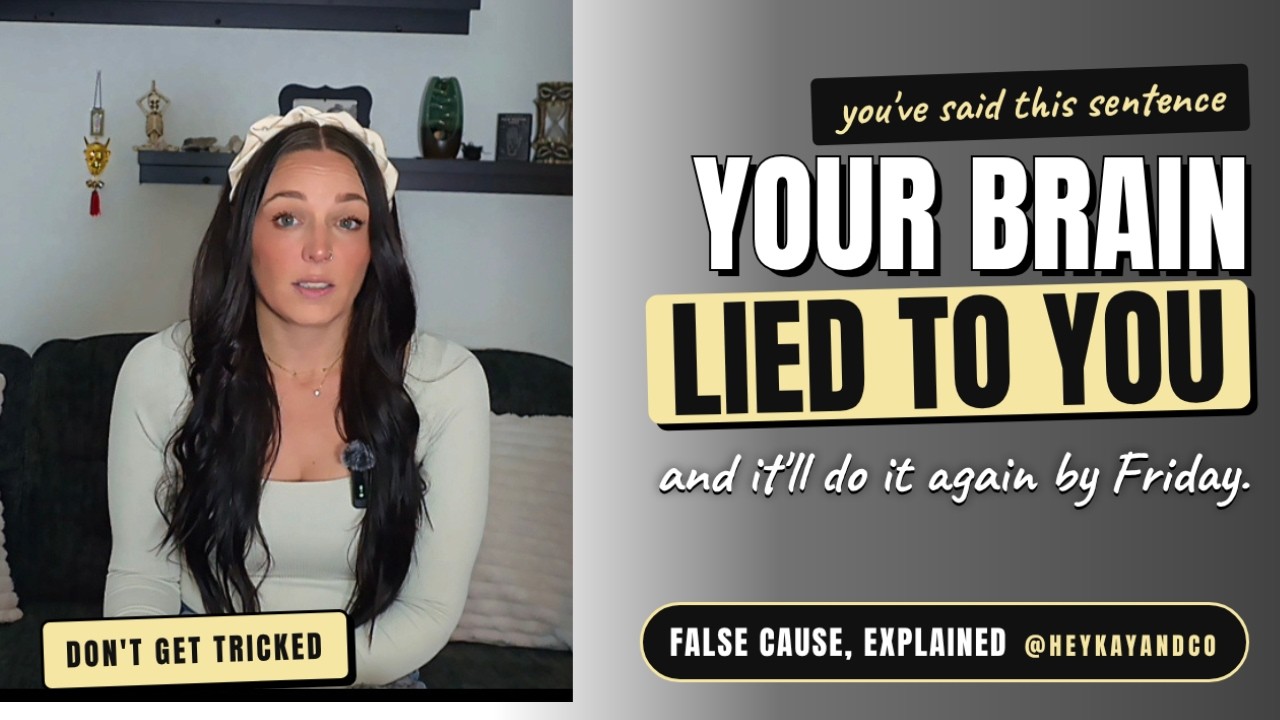
The full 4-minute video. Everything in it is written out below.
What it is
Two things happened close together, so your brain files the first one as the reason for the second. It doesn't run a check. It just closes the file and moves on.
Take the collagen. Fingernails grow about three and a half millimeters a month whether you take anything or not. The collagen didn't earn that. But now the collagen gets credit, and when a nail breaks next month, the collagen won't get blamed for it.
Notice that. The trick only runs in one direction. The thing you already believe in gets credit for the good stuff, and the bad stuff gets explained some other way. That's how you can believe something works for years without it ever being tested once.
What it sounds like at home
"I didn't study and I still got a B, so studying doesn't matter."
The test was easy. One easy test is luck, not proof. The next hard test is going to be the real answer.
"I wore my lucky hoodie and we won, so I'm wearing it every game."
The team practiced all week and the other team was missing two starters. The hoodie was there. That's all the hoodie did.
"I had candy before the test and I did great, so candy helps me think."
Ask what else happened that morning. Probably more sleep than usual, or a test on the one chapter they actually liked.
What it sounds like from adults
"I switched checkout lines and mine moved faster, so switching works."
You remember the one time it worked. You don't remember the six times the new line stalled behind a price check.
"I knocked on wood and the Wi-Fi came back."
The router was already restarting. You'd have gotten the same Wi-Fi without the knock.
"I started vitamin D and I stopped getting sick."
Maybe. You also started it in April, when everyone stops getting sick. Winter ending is a pretty big "something else."
The "bad day" one is different
"I said it was going to be a bad day, and then it was." This one isn't quite the same trick, and the difference matters.
The lucky hoodie did nothing. Saying "bad day" did do something: it told your brain what to look for. For the next ten hours you noticed every red light and skipped every green one. The day wasn't worse. You were counting differently.
So something real did cause it. It just wasn't the words. It was your attention. That's why this fallacy is tricky: sometimes the first thing really is connected to the second, and the only way to know is to check.
What it sounds like online
"This town banned sugary drinks and obesity dropped."
Did it drop because of the ban, or did it drop in every town that year? They won't tell you. They're counting on you not asking.
A graph with two lines going up together and a headline that says one caused the other.
It's the same mistake as "every time I wash my car it rains." The only difference is the graph, which makes it look like proof instead of a superstition.
A before-and-after photo with no dates and no list of what else changed.
Two photos can't tell you why something changed. They can only tell you that it did. What happened in between is the whole story, and it's usually missing.
The one I almost got away with
I sell hair products, so my hair is the thing I'm showing you. That makes me the easiest person on this account to catch doing this.
I started using a dry oil, and my hair felt softer the same day. I could have said "this oil made my hair softer," and most of you would have believed me, because it was right there on camera.
But I'd also just trimmed my hair that same week, and a trim makes your ends feel softer whether you put anything on them or not. Two things happened, and I only wanted credit going to one of them. That's the trick, on me, in real time.
So I told you about the trim too, and I told you I'd keep using the oil and come back with an update. I'm not making a call off one day when something else that happened that week could be the cause.
I've been taking photos of my hair since 2020, and I've been on the same routine since 2024. One before-and-after is a story. Years of them, with the trims and everything else written down next to them, start to look like real information. The routine I'm actually on is on my shelf.
And if you ever catch me doing this and not saying so, call me out. Respectfully, but call me out. That's how this works.
The one question that catches it
What else was going on at the same time?
If nobody can name anything else, fine. It might really be the cause. If you can name three other things, it's a story, not a fact. And if the person gets irritated that you asked, that tells you something too.
That's the question I asked myself about the oil. The answer was a trim, so I said so.
When you're the one about to say it
Change one thing. Leave everything else alone for about a month. Then look.
That's how we try anything new at our house. If we start a new rule with the boys, nothing else changes for a month: not bedtime, not screens, not chores. Because if I change three things and something gets better, I have no idea which one did it, and I'll spend the next year telling people the wrong one worked.
Two things in a row is not a reason. It's a coincidence until somebody does the work to prove it isn't.
Feel whatever you feel. Then check. One a week, follow for the next one.
The book behind the series.
The Tuttle Twins Guide to Logical Fallacies. Written for kids. Works on adults. It's the one we pull off the shelf at our house.
Questions
What is the false cause fallacy in simple terms?
Two things happen close together, so you decide the first one caused the second without checking. Sometimes it did. The fallacy is skipping the check.
Is false cause the same as correlation vs causation?
Close cousins. Correlation means two things show up together. False cause is treating that as proof that one caused the other. The Latin name, post hoc ergo propter hoc, means "after this, therefore because of this."
What's an example for kids?
"I didn't study and I still got a B, so studying doesn't matter." The test was easy. One easy test is luck, not proof.
How do you catch it?
Ask what else was going on at the same time. If you can name three other things, it's a story, not a fact.
How do you test whether something actually worked?
Change one thing, leave everything else the same for about a month, then look.
Keep reading
 The one beforeAppeal to emotionSomeone hands you a feeling and hopes you don't notice there was supposed to be a reason.Read it →
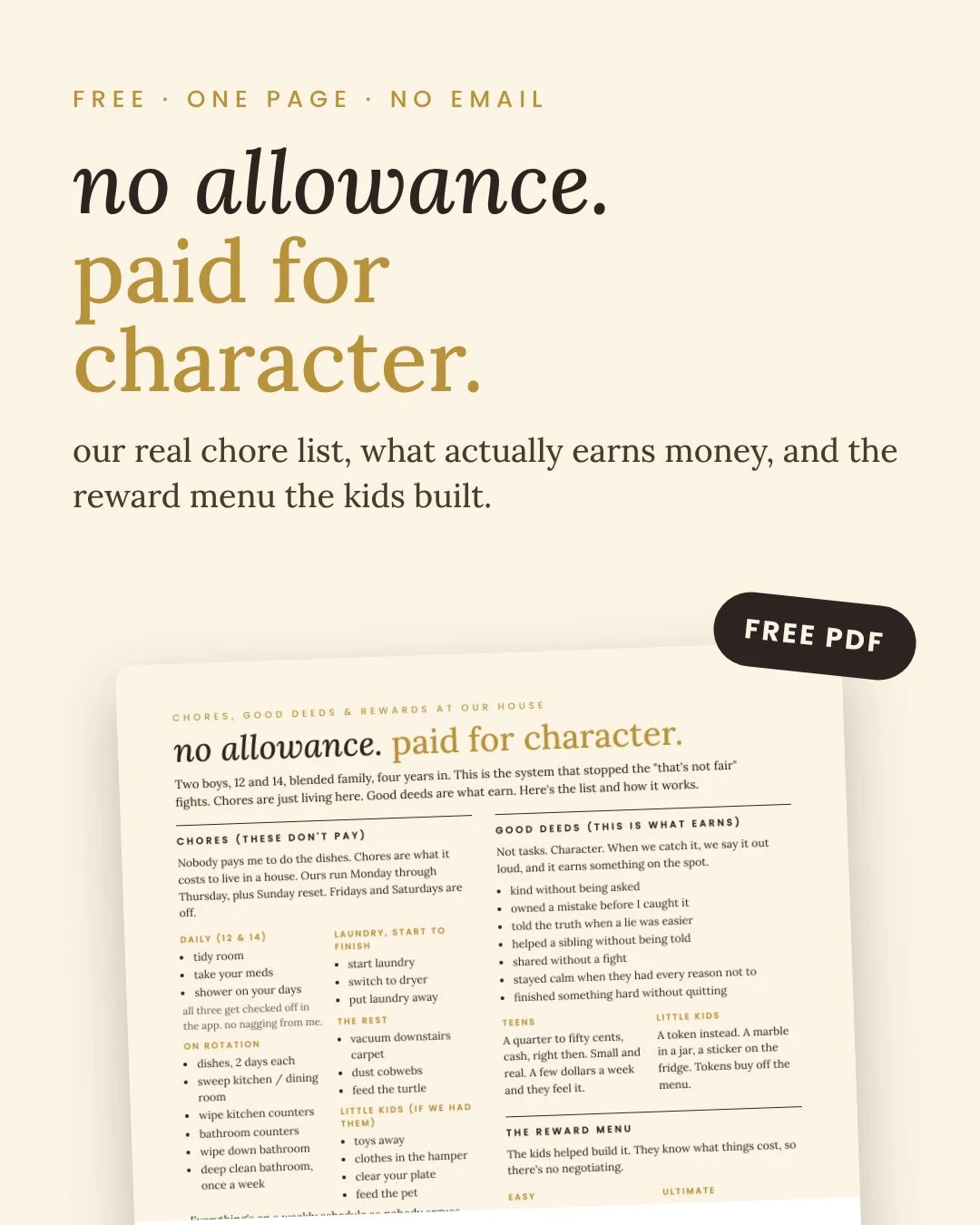 Run our house · freeNo allowance. Paid for character.Our one-page chore guide for kids and teens: the chore list by age, the good deeds that earn, and the reward menu the boys built.Get it →