Run our house · free
No allowance. Paid for character.
Our one-page chore guide for kids and teens: the real weekly chore rotation for two boys, 12 and 14, what actually earns money at our house, and the reward menu they built.
 free · one page · print it
How We Do Chores
Two boys, 12 and 14, blended family, four years in. The whole system on one page.
Download the PDF →
@heykayandco
People kept asking me for our chore list, so I put the whole thing on one page. This page is the long version, for anyone who wants to know why it's set up the way it is before they print it.
Here is the short version. Chores don't pay. Good deeds pay. The kids built the reward menu, and two rules keep the whole thing from turning into a fight.
Why we don't do allowance
Nobody pays me to do the dishes. Chores are what it costs to live in a house, and I wanted the boys to learn that before they live in one of their own.
The problem with allowance for chores is that it turns every task into a negotiation. Is making the bed worth a dollar? What if it was only half made? What if he did it but his brother didn't? We lived in that argument for a while. We don't anymore.
So we split it. Chores are expected and unpaid. Character is noticed and paid. That one change did more for our house than any chart.
The chore list
This is the actual list for a 12 and a 14 year old. None of it pays. It's just what living here looks like.
How it runs. Chores go Monday through Thursday, plus a Sunday reset. Fridays and Saturdays are off. Everything is on a weekly schedule, so nobody argues about whose day it is, and the three daily ones get checked off in an app. The app tells them. I don't.
Daily
- Tidy room
- Take your meds
- Shower on your days
On rotation
- Dishes, two days each
- Sweep the kitchen and dining room
- Wipe kitchen counters
- Bathroom counters
- Wipe down the bathroom
- Deep clean the bathroom, once a week
Laundry, start to finish
- Start laundry
- Switch to dryer
- Put laundry away
The rest
- Vacuum the downstairs carpet
- Dust cobwebs
- Feed the turtle
Little kids, if we had them
- Toys away
- Clothes in the hamper
- Clear your plate
- Feed the pet
Extra jobs can pay
Real jobs with a real price, agreed on before they start. The backyard, the cat litter, the garage, washing the car, the stairs, organizing a closet. They ask for one. We set the number. Then they do it. No one gets paid for a job they weren't asked to price first, and that rule has saved us a lot of "but I thought" conversations.
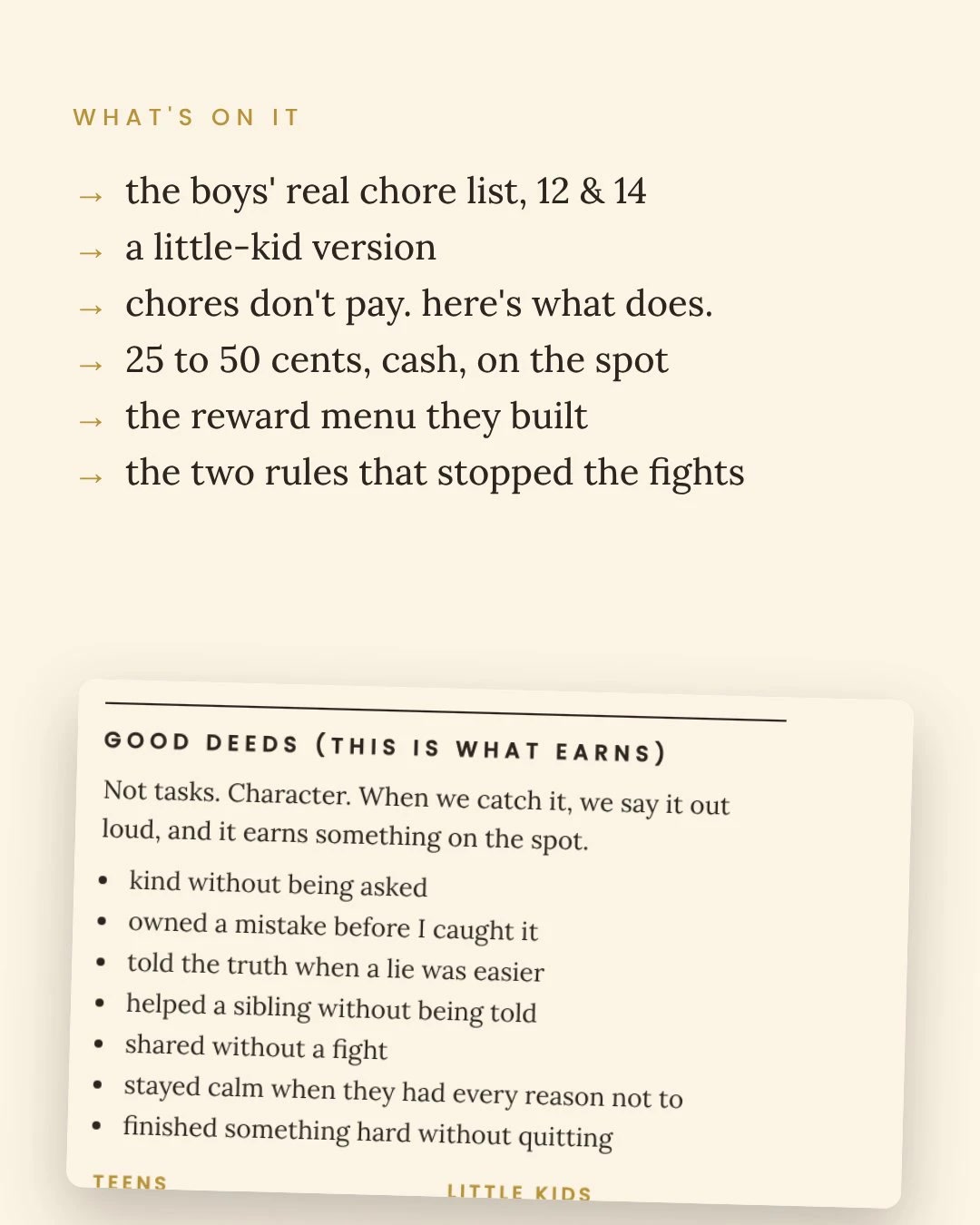
Good deeds are what earn
This is the part that isn't about chores at all. We watch for character, and when we see it we say it out loud and it earns something right then.
- Kind without being asked
- Owned a mistake before I caught it
- Told the truth when a lie was easier
- Helped a sibling without being told
- Shared without a fight
- Stayed calm when they had every reason not to
- Finished something hard without quitting
Teens. A quarter to fifty cents, cash, on the spot. Small and real. It adds up to a few dollars a week and they feel every one.
Little kids. A token instead of money. A marble in a jar, a sticker on the fridge. Tokens buy rewards off the same menu, in a size they can hold.
Saying it out loud matters as much as the money. "You told me the truth when a lie would have been easier. That's fifty cents." They hear the reason every single time, and after a while the reason is the thing they remember.
The reward menu
The boys helped build it, which is why it works. They know what everything costs, so there is no negotiating in the moment. Teens spend cash. Little kids spend tokens.
Easy
- Ice cream for dessert
- DJ in the car
- Skip one chore
Medium
- Pick family dinner
- Extra 30 minutes of TV
- Park of your choice
Ultimate
- Movie night in the front room
- Living room campout
- Beach day
Even with cash on the table, the thing they save for is almost never stuff. It's time with us. Build your menu around that and the rest takes care of itself.
The two rules that ended the fights
Nobody cashes out alone. If one brother is way ahead, the other has to catch up before either spends on a family reward. It sounds harsh. It's the thing that turned them into a team instead of competitors.
We don't remind them. If you earned it and forgot to claim it, it's gone. They learned to keep track of their own money fast, which was the point.
How to start this at your house
Print the page. Sit down with the kids and build the reward menu together before you do anything else, because a menu they built is a menu they won't argue with. Then take our list, cross off what doesn't fit your house, add what does, and put it on the fridge. Start catching good deeds that same day, out loud.
Give it a month before you judge it. The first two weeks are them testing whether you mean it.
Get the one-page guide.
Free. Direct download. No email box. Print it or keep it on your phone.
Questions I get about it
Is the chore guide really free?
Yes. One page, a direct PDF download, no email box, no signup.
Why no allowance?
Nobody pays me to do the dishes. Chores are what it costs to live in a house. Character is what earns money at ours.
What ages is the list for?
The main list is the real weekly rotation for our 12 and 14 year old. There's a little-kid version on the same page, and little kids earn tokens instead of cash.
How much do your kids actually earn?
A quarter to fifty cents per good deed, cash, right then. A few dollars a week. Extra jobs have a price we agree on before they start.
Does this work in a blended family?
It's the thing that stopped the "that's not fair" fights in ours. The two rules do the work.
